Wednesday, 17 August 2016

Follow-up to an Unusual Day ...

There will be NO middle-man ...  
Taking a pause after harvesting Cassava
Bunong lady
Mondolkiri Province is a large and sparsely populated rural Province that borders Vietnam.   It’s home to the Bunong people – the indigenous people who have lived here for many years.  Some of the Bunong people practice their traditional semi nomadic lifestyle living off the forest through hunting, collecting fruits and plants.

However, more and more Bunongs have chosen a different lifestyle.   They have settled and established small communes with smallholdings producing rice, cassava, vegetables and life stock.    

Bunong Students minding their younger siblings whilst at school
Usually, these communes have a small school with 2 to 6 classrooms and 50 to 200 students.  Students are taught from grades 1 to 6.   However, Student attendance drops off greatly at the later grade levels because children are required to either help collect produce from the forest or grow produce on the farm.  Teachers in these schools are typically Bunong and have a grade 9 Education.   
Bunong teacher teaching with her son
Teachers in these remote schools have been dependent on receiving their salary from the DOE via the POE.  Now very recently the government has decided that teachers will be paid their salary directly into their own personal bank account.   In early February 2014 ACLEDA bank staff were busy in the schools opening bank accounts for the teachers.

Throughout Mondolkiri Province, teachers will now be able to travel to Sen Monorom or to ACLEDA ‘apartment’ banks to withdraw their money.

February 19, 2014, Teachers were interviewed and were asked how they felt about having their own bank account.   See below answers from teachers and school directors:
-------
“VSO/Cuso International has helped with you getting a bank account by working closely and advising the government: the Ministry of Education.  VSO /Cuso International would like to know how you feel about this - getting your own bank account?” 

Krob Khna – Bunong Teacher
Are you excited that you now have a bank account?
“Yes I’m excited to have a new bank account.   I can get my salary anytime I want.  It is much easier to get my salary from the bank”.   
Sadin Sreymao – Bunong Teacher 


“Yes, I’m happy to have a bank account. In fact, I’m very excited because the State –the government has made it mandatory for all teachers to open a bank account to secure their money” .  

Kroye Chet  - Khmer School Director


Is having a bank account important for you?  Why?
“Yes, because when I go to the DOE in Bousra to collect  my money, I’m never sure if I’m going to receive  it.  The DOE doesn’t always have my salary.  I have to wait many months for the DOE in Bousra to pay me because the DOE didn’t collect  my salary from the POE in Sen Monorom”. 

“This is a very long process and during the monsoon season we are not able to reach Bousra because the roads are not good to travel”.
“Now I can go directly to Sen Monorom and collect my money from the bank”.

“This is how the system works: 
-       The POE goes to the Provincial Bank in Sen Monorom to take the money out.
-       The POE contacts the DOE in Bousra to let him know that the teachers’ salary is at his office.
-       The DOE goes to the POE in Sen Monorom to collect the teachers’ salary.
-       The DOE contacts each school directors to inform the teachers that the money is waiting for them in Bousra.”     
Sarun Seyen – Bunong Teacher
Does it make you feel respected by your family, friends, community  now that you have a bank account?
“Yes!  My family, my parents and my community are so proud that I now have a new ACLEDA account.  It gives me a sense of pride”. 


Neyso Kon– Bunong Teacher 


“Yes, I feel respected more than before because my family told me that the DOE will not ‘cut’ my money anymore.   My family is very happy for me that I will have a bank account.  They will not worry about me anymore.  They will know that my salary is in the bank and will not be ‘cut’ [and will be secured] by the bank”.    


Yun  Sokhun – Khmer School Director
“Yes. My friends,  my family, my community ask me ‘where are you going?’  I tell them,  ‘I’m going to ACLEDA bank to get money’.  People respect me because of this”. 


Tun Oeung and Khay Tola - Khmer Teachers


Do you expect to receive a full salary?  How will you know?
“When I get my salary at the DOE in Boursra, there is a list of names and salaries posted on the wall.    Now, the government will put our  money directly in our bank account.  
There will be ‘NO’ middle man”.
Sarun Seyen – Bunong Teacher 


“Yes.  I listen to the radio.  The government announced that all teachers throughout Cambodia will receive a ‘full’ salary.  No one can ‘cut’ their salary”.


Bunong Teachers


What are the benefits to you  both with having a bank account?
“When my money is in the bank it will grow”.

 “I know about interest because I read the ACLEDA document the bank people gave me.  I read the bank document  ‘very carefully’ and I found out that my money can grow”.


Neyso Kon – Bunong Teacher
“When I keep my money in the bank it has ‘security’ and I can also get interest.  I heard it from my sister.  My sister has a bank account’
Yun  Sokhun – Khmer School Director


“ When I go to my homeland ‘Tae Kaev Province’  I can withdraw my money from there also”.   

Yoy Bora and Roeun Len - – Bunong Teachers


“There is benefit for me.  I spend less money to travel to Sen Monorom.   Sometimes we have to call the DOE in Boursra to ask ‘where are you?’"

‘Sometimes they work and sometimes they don’t work’. 

With the bank, I know I can count on my money to be there.  I don’t have to wait for anyone to give me my salary”.   

“My salary is more safe and secure.  I will spend less money, less time for travel”.
Khay Tola – Khmer School director

Where will you withdraw your money from?    “Sen Monorom”.       “It will be much easier than travelling to Boursra  ‘’The road condition to Bousra is treacherous. It’s rutted and dusty in the dry season and slippery during the monsoon season!”   
Khong - Khmer Teachers

When will your bank account be opened?    “April 1st , 2014”.    

When will your first salary be deposited?   “The POE will inform all teachers / school directors”        
How often will you receive your money?    “Once a month”. 

 Let Savy – VSO Volunteer Translator /Khmer Language Teacher


Savy my VA (who is also a teacher for the States) was responsible in translating the interviews with the teachers.     “I think that it’s good for the teachers to have a bank account because they can spend less time, and less money to get their salary.  Teachers can be more independent and if they want to save money and earn interest then they can”. 
‘’The road condition to Bousra is treacherous. It’s rutted and dusty in the dry season and slippery during the monsoon season!”   
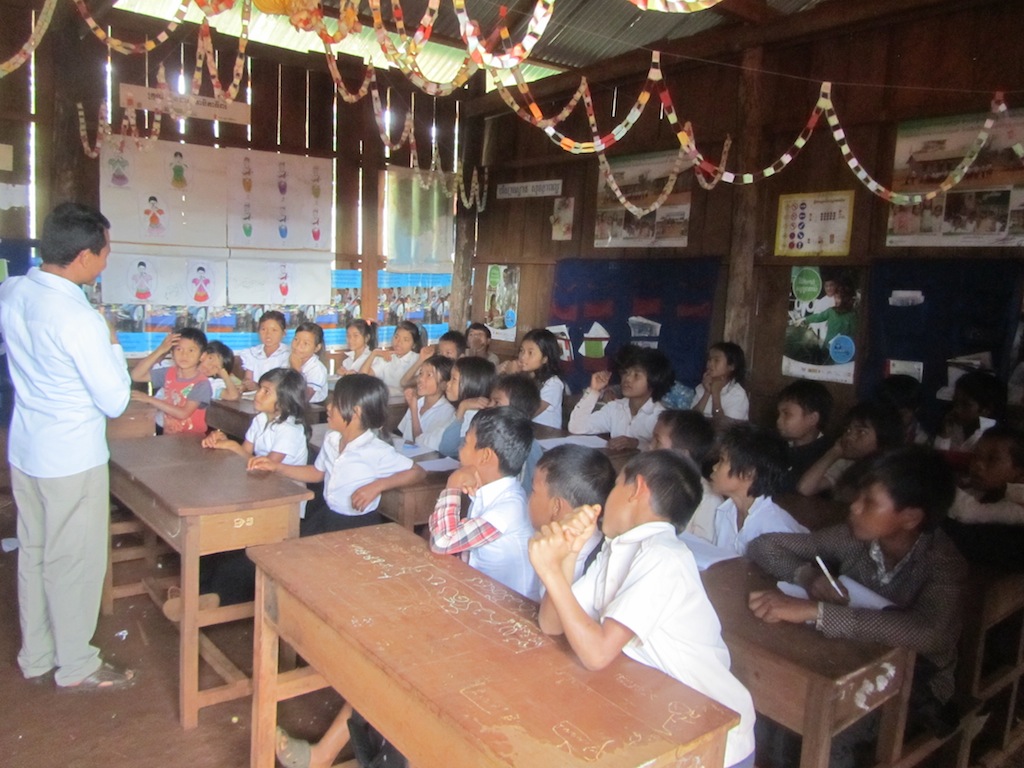
Bunong students paying close attention to their Bunong lesson

*Photos were taken with the teachers/school directors permission to up load on any website or to be printed in newspapers or news letters.

More later :)

Tuesday, 16 August 2016

An Unusual Day

Teachers Get a bank account ...
Bunong Teachers and school directors marking this unusual day ...
Thursday, February 6, 2014, Savy my VA and I were scheduled to visit the cluster village schools in Buchi Ri Commune to observe, discuss and identify the needs of the schools. 

As usual, we had scheduled our meetings during normal school hours and expected, as usual, to be greeted by children playing outside, because not all teachers are as usual, in attendance.  We expected, as usual, to have to phone teachers and school directors and remind them of our meetings or to reschedule.   
Lent my glasses to the school director to thumbprint his bank documents
But today was VERY unusual! To our surprise …  Every Single Teacher, and, school directors both in the ‘Primary/Secondary Panel’ were present at Kumamekong Vilage School.  They were waiting for staffs from ACLEDA Bank Plc. to arrive at Kumamekong Village School to open their own personal bank accounts.

During the process it was interesting to observe that teachers identified themselves with a thumbprint rather than a signature. Added to this, I lent one of the teachers my glasses to enable him to ‘thumbprint’ his
A teacher at the back of his friend's motorbike is Carefully reading his bank documents ...
bank documents.  Teachers wanted their photos taken to mark this 'unusual' day.  On the way home, one of the teachers on the back of a motorbike was carefully reading his bank documents that he was given minutes earlier.  

Truly a moment to remember ...
Both school directors and teachers were happy that they were being paid directly by the government and that they would no longer be victims of the mysterious ‘deductions’ they incurred from their meagre $100 a month salary when they were dependent on their supervisors to obtain their pay. 

'Tis truly a moment to remember ...   

Teachers get bank account ...

"The reform of payment system of teachers salaries has been stated policy change of VSO/Cuso Internatinal-Cambodia and our Education Advocacy Partners (NEP and CITA) since 2011 so we are delighted that after two years of  research, campaigning and lobbying this change in now been implemented.  This achievement stands as credit to all of our volunteers and education advocacy partners and demonstrates how VSO/Cuso International -Cambodia can play a role in closing the circle between national policy and changes in practice and policy which make a real difference to the lives of teachers and students.


 Thank you all very much for your commitment to bring about this significant change."  VSO Cambodia
 'Sharing Skills, Changing Lives'

More later :)

Tuesday, 19 July 2016

Stepping into Another Time ...


A road less travelled
... connecting through the hearts the minds of the people

Before the change: Stepping into another time - in the Bunong villages,  into a ‘road less travelled’ - in poor and isolated remote communes throughout the 5 districts of Mondulkiri  province: Sometimes teachers come to school, sometimes students come to school.  Other times, due to low teaching wages, teachers work on the farm, have family commitment and/or spend time working at several jobs to make ends meet.  As a result, teachers spend limited time preparing and delivering a high standard curriculum for their students.  Echoing similar concerns in the community;  it is essential for children to contribute to the survival of the family. Therefore, they are normally out  in the fields, a usual obligation for children to help their parents; either to harvest mung beans, plant cassava, collect resin
Observing a lesson
in the forest, work in rice fields and more.   Seasonal food production work  is critical to the village people and salvaging their crop will always be a priority for the people here.  For example, if the village people don’t harvest their beans before the rain comes they will spoil, sometimes, alas, to a detriment of their own education.  
Other than the number of issues teachers faced such as lack of commitment to their students, when we first arrived in Mondulkiri in 2013, we also noticed during that same period of time that Khmer teachers were unevenly matched to Bunong or
Poster Competition - Why go to School?
Cham village schools where they did not speak the children’s language.  What’s more,
my POE partner, despite the  above number of dilemmas described,  had nevertheless instructed me to phone the schools prior to my regular visits to ensure that teachers and children were at school.    However, when I arrived at the village schools, teachers who reluctantly had showed up at the same time as us (because they were requested to attend school by the POE), only to claim that they had been ‘called away to yet another ‘unannounced’ meeting with the DOE or had to leave school because they had other work or  family obligations. 


Bunong students receiving a lesson in their mother tongue
Working together with teachers and students
What changed? What did we – the POE, the Ministry of Education - VSO collectively do to meet the needs of teachers and students during our time in Mondolkiri?   Before changes became evident, meetings, conferences, more meetings took place among  national and sub-national officials, NGOs including VSO:   A t the 2015 Annual Congress Conference,  cluster chiefs and school directors from the 5 districts gathered to share their findings for the 2013 -2014 school year with the POE director.   The three common denominators were to:  provide more money for schools, improve road conditions and encourage regular school attendance both from teachers and students. Ironically, a week after the Annual Congress Conference took place, the Minister of Education (from Phnom Penh) came to Mondolkiri to talk to cluster chiefs and school directors about the new ‘5 -year strategic education plan’ to improve the quality of teaching
Teachers taking on the challenge to test and to use new teaching tools
throughout Cambodia.  He promised that more money would be spent on Education and that teacher’s salaries will be raised over a 5 year period.  Another key issue that the minister of education raised was the relevancy for the Multilingual Education programme that was recently and successfully implemented in Mondulkiri Province by Bunong teacher trainers, Care and VSO.  Furthermore, he wanted to ensure that there was a continued focus on ‘minority inclusion’ in the main northern eastern domain.  Today however, the Multilingual education programme is sustainable and a great success at that! 

How did the change happen?   Throughout the 2013-2016 school year, my POE colleagues and I continued to conduct ongoing meaningful training workshops (E.g.; Math games, Inclusive education, Love of Reading, Khmer/Bunong Language curriculum, MoEYS English for Cambodia, Health education and more) with cluster chiefs, school directors (to support their
Conducting training workshops with cluster chiefs and POE staffs
teachers), and teachers
who took on the challenge of using these new initiatives, teaching tools, (that they had just learned),  to test it and  to use it in their village schools over a 4 week cycle before the next workshop took place..  A follow-up schedule was also given to teachers for us to visit, support, guide, observe and to address any concerns.  We  also indicated that we were available to visit teachers and school directors at their convenience should they require immediate assistance, before our regular scheduled visits to the school villages took place. Throughout, our time, our near 3 years in Mondolkiri, we routinely empowered teachers with regular mentoring/ coaching support, building trust and building close relationships - connecting through the hearts - the minds of the people ….    Furthermore, (throughout the course of our time with the POE), we also received reinforcement and positive feedback from the POE/DOE for supporting and working with cluster chiefs, school directors and teachers toward improving a higher curriculum standard.

Observing a Khmer lesson
What are teachers doing independently? There were times, during the last year of my placement in Mondolkiri (once teachers got the hang of things and were becoming increasingly confident in their teaching),   that we did spot checks in some of the  school villages;   We were pleasantly surprised to find that teachers who were trained ,were present and prepared, even when we came unannounced!  Both school directors and teachers welcomed the feedback that we gave them.  They appreciated our comments as well as the guidance and even asked for more.  They
Receptive to constructive feedback
said that ‘our feedback, regular support and mentoring  was extremely useful for their own professional development, their learning and their teaching  ... ‘ 


What’s more, my (Volunteer Assistant) VA and I planned our activities around the teachers’ and students’  schedule to ensure that everyone was included and reached.   With time, during our time in Mondulkiri, we began to notice a change in the people’s attitude toward education – a good change at that!  A higher number of teachers came to school regularly and,  good teaching practice  became evident; Teachers  were now more committed to
Village chiefs and teachers visiting with Bunong families to encourage children to attend school
students to teach  a ‘thorough’ curriculum.   In some cases, the community got involved; the village chief together with teachers visited families in their home who’s children had been away from school for more than two days..  Rationale:  to encourage children to return and to stay at school.


More Bunong children are now attending school regularly

Underneath the tangles and priorities on the value of education, with time however, it was better understood.  Not only did parents who initially felt that going to school was of secondary importance, who’s children spent more time away from school and who were given the impression that school was a privilege only for a few, began to show enthusiasm about education. They began to understand the link between school attendance and reaping the rewards of education. They began to understand the significance of Education for All!  As a result of these new insights, an increasing number of children began to attend school regularly …

More milestones throughout the course of our near 3 years In MondulKiri :

More money is spent on education and on teachers’ salaries, and an end to corruption is finally coming to light: Collecting 500 riels (12cents) a day from children was banned. Parents who could not afford the bribe from teachers now send their children to school regularly. 

For the first time, in February 2014, teachers opened their own personal bank accounts.  They now receive direct payment from the government as a result from a two year research (2011-13), campaigning and lobbying (credited to a group of NGO’s, VSO/Cuso International and the Ministry of Education): see short case study and follow up interviews – on ‘An Unusal day – teachers get back account  on the next post.

Bunong parents sending their children to school
Potential Bunong in-service teachers are now deployed in their Bunong home villages throughout  Mondulkiri province to teach the Multilingual (Bunong) Education Programme (approved in 2015 by the Ministry of Education) and to assess children in a language they understand, a language where they feel a sense of belonging.


More girls and children from remote Bunong villages throughout Mondulkiri province are staying at school.


Some village schools (E.g.; Poulong Village school) have become a model school for other schools in Mondulkiri province.


Roads throughout Cambodia, throughout MondulKiri province and, on the way out to the villages are improving:  As a result, (other than VSO/Cuso International), Caritas NGO who had previously helped Srae Y village with a number of health projects, built a  brand new school for the people of Srae Y Village now that the road to the village is in better condition and equipment can easily be transported to the village.  Note: the school was finally built in April 2016 during the 3 week Khmer New Year holiday, during the children’s school break.


Corruption-free grade 12 exams are now strictly regulated by the government throughout Cambodia.
Children reading a book written and illustrated by young Cambodian writers
More Cambodian writers, young writers and illustrators are writing children’s books, novels, journals for the Cambodian public to read and to enjoy.  That is wonderful news! 

More later :)