May and June spun into
one.Both months were filled
with a constellation of events and activities.
In early May, Kevin and I arrived
in Yangon for a 2 week training orientation; to experience, to get a taste of
Myanmar whilst partaking and familiarizing ourselves with invaluable information
about Myanmar before we were sent-off to our placements. Nay Pyi Taw for
us.
Nay Pyi Taw, the new government
capital city of the Republic of the Union of Myanmar, and centrally located, is situated north of Yangon and lies southwest from
Mandalay.SuSu , an extremely helpful Cuso
staff accompanied us bybus to our
endpoint and,together with a local taxi and a
handy man in every aspect of the word, whomet us at the Thebagon bus station, drove us to our new home.
After a comfortable bus
ride from Yangon to NPT, we were pleasantly surprised to find that NPT is more developed than
expected (some areas more than others), and appears to be an agreeable place to live in,
provided that one has their own transportation and is free to come and go as
they please. Equally pleasing, was to
find that our new home is in the heart of a local community; and, that the Swe Ja Bae local market is within
walking distance. After living out of
suitcases and backpacks for 2 weeks, we were glad to unpack and air out our
‘musty’ clothes –let alone to finally indulge in cooking our very own
wholesome food.
That evening and all the next day,
a well-seasoned volunteer, Carol, who only had a week left with her placement,
took the time to show us around the city; to show us where the shops and some
of her favourite local restaurants were in NPT.We also ended up having lunch with her at Santinos – her favourite place to eat.
Monday morning, on my arrival at the Parliament, on my first day of work,I was
introduced to the partners.Unlike
Mondolkiri, Cambodia where I was greeted with open arms, where the education
director had gathered all staff together outside the education complex (to introduce the new primary education advisor) to deliver a speech with his horn, to tell them that I will be sharing office with primary education staff to learn the Khmer language, to learn from each other, I was instead shown to my new office (shared by
another NGO and her interpreter), to my desk.Shortly after my initial disappointment,
rather, what was I thinking?, the same older
woman came in with several cleaners to my new office to instruct them to move
my desk exactly in line with the others, where my desk would firmly be placed. The same individual then proceeded to take the place of my assigned Line Manager, (who was evidently new
in the field,) and promptly signed my document (instead of my line
manager who appeared to show little interest in the situation? - was he nervous too ?).At first, I wasn’t sure what to make of it
all.However, things improved quickly!
A week later, the new line
manager took hold of the reigns. I moved office. (My original office was reorganized and taken
over by a number of staffs from another department) . I was given the choice of having two offices
with 2 desks: A shared office with a
group of foreign NGOs and/or move in with the Research parliamentary staffs
where my Line Manager and his assistant were based.I chose the latter. To me it made perfect sense to work among helpful
Burmese staffs , learn the language,, to learn from each other as I did in Cambodia, to learn about the parliamentary system … and much more.
****
June
Before we new it, June came
and went! Throughout the month of June,
it seemed I had ongoing birthday celebrations; from birthday cakes to
dinners to outings.My daughter, who
had just returned from a canoe trip with her partner and colleagues, had sent
me a priceless birthday gift!
"Happy birthday maman; I hope your next year brings you so much life, laughs and adventure.
I
took this photo on your birthday while I was on a trip thinking of you.
It was taken at Cow Bay in Cayquot - Was a magical experience. Sending you one million hugs, So much love - love you lots xoxo Léah"
June was a month where the locals
repaired and prepared our dusty road for the much-needed-anticipated rain.All the potholes on our little dusty lane
were filled with a variety of rocks and of different sizes. Once filled, every
pothole was coated with loose gravel.Our neighbour in charge of this process, instructed the neighbours with
a specific task.Children, in twos and in fours, ran back and forth to the dirt pile ,
outside our neighbour’s home, filled either their buckets or stretchers with
enough gravel to neatly smooth out the holes
done by the elders.
Heavy rains did come.Only for a short while!The ground is bone dry, and at the
Parliament, the grass is watered every day to upkeep the well manicured grounds.
July is near and there seem to be no
sign of rain.
Elsewhere in NPT, though we‘ve raved to
some people how lucky Kevin and I were to live in our own
house, instead of a hotel, we did have a bit of a scare.One morning, without warning, while I was at
work, , 2 immigration officers and a local chief pounded on our front door.They wanted to know why a foreigner lived in a house
instead of a hotel?Kevin was promptly
asked to show our passports and visa papers.All the while, throughout the commotion, awaiting for clarification; awaiting for some type of response from the Cuso Mayanmar office, Burmese chatter between the 3 men buzzed around Kevin's ears, wondering if their may be a slight possibility of being evacuated from our house to a hotel.In the end however, after lengthy discussions between
Cuso SuSu and an immigration officer, Kevin was told that we could stay.Within 24 hours of this mishap, Cuso had
contacted the immigration department in Yangon to straighten things out and to confirm our stay in our house.Thank goodness!
A couple of days later, 3 anti –
malaria health –care providers with the same village chief (that came with the immigration officers) appeared at our house to place anti-malaria
dissolving (tiny brownish) pebble bags (that everyone pocked holes in) in our water harvest.They told us that this was a normal yearly procedure done throughout the
communities in NPT to prevent mosquitos from building larvae in still water –
thus eradicating, preventing malaria or dengue fever.To solve our problem, we decided to leave the faucet open, draining the
water completely out of the water harvest when it rained.
As for work, I thoroughly
enjoy working together with staffs, MPs and my class. I have an open door policy where my students
come and go as they please.Some have
early morning commitments but still manage to attend my class. When I prepare for the next day, some students
will pop in to ask if they can help and or simply hang out!I love my students – they’re so humble and
hungry to learn.
As for my line manager and I, together we're learning the ropes - making lemonade out of two lemons ... He's understanding: he's a breath of fresh air to work with. I feel so lucky!
More
later … : )In the meantime, Wishing you fun reading and lots of laughterfor the next coming month.
There are no cows roaming the streets, or are lined neatly on the road across
from us waiting to be lead to their water post in the nearby ravine. There are
no milk apples nearby or in the village.
It’s Saturday! It’s early morning.A young Buddhist Monk, clad in a red maroon
robe, strolls down on our street striking his triangular-brass-shaped gong with
a small mallet emanating a soundthat
isboth relaxing and calming.The gong’s chime, echoes energy across the narrow
dirt road to alert the locals that a group of Monks, young and old, who rely
heavily on the community for food donation, are about to do their regular
rounds.
In the distance, possibly two houses
across from us , nursery school children sing in Burmese to welcome the
day.Whilst two boys, one of them
carrying a little girl onhis back, rush
out of the house with a thud, giggling and echoing the Burmese chorus.
Contrary to the calming sound effect we heard earlier, motorcycles with
passengers on back seats, rumble by to and fro the dirt road, and head to the
market for fresh produce.
We've definitely
lucked out!We live in a little
community similar to rural Mondolkiri, Cambodia. We have an Asian style
bungalow surrounded by other humble homes.It reminds me very much of our home in Mondolkiri, except that our home
here in Nay Pyi Taw is little grander and has a proper ceiling in the bathroom.
Our Mondolkiri bathroom had no ceiling, and as a result after every
shower , talcum-red-powedery- dust,if we weren’t swift
enough to escape the drizzly dust, sprayed down on our anticipated arched backs.
Further to our
delight, beautiful luscious bushes, floral trees, and, fruit trees surround us:
Bougainvillaea’s are in full bloom
emitting stunning mauve tissue like flowers.We also have Banana, and mango trees.Mangoes are abundant this time of
the year and, each day, ripe mangoes from several trees in our
garden fall down on our doorstep ready to eat for breakfast!What’s more, we’ve just discovered that we
also have our very own pomegranate bush; it appears that we may have a ripe pomegranate almost
everyday for the next little while. Awaiting to bloom, just across our
porch, under one of our mango tree, potted orchidsneatly hang on a wired line; some grafted to
both a mango and a boungainvillaea tree, During our first
week here, Kevin and I attended an expat dinner at one of the hotels to meet
other working expatswho most of them
live in hotels during their stay here in Nay Pyi Taw.Fortunately, we live in our own little
diamond in the rough where we can experience the real local Myanmar Asian
lifestyle. By the way,
there are several pockets, of other hidden treasures throughout Nay Pyi Taw, of
little local communities like ours that are
also tucked away from the main large multi-lane roads.
Nay Pyi Taw,
built in 2005, and now the capital government base city of Myanmar, is semi
arid with fewer trees than Yangong.The
heat is unbearable with little shade wherever we are.Thankfully, the air con in our house was fixed
late last night. So, yes, we're very much looking forward to
the rainy season, which is suppose to start this coming week.With the rainy season, hopefully the rain
will cool things down, at least, for a little while .
I’ve been at
work, at the parliament for one week already and everyone is dressed impeccably. The women are clad in graceful aqua-blue
longyis that resembles the colour of the ocean.The longyi is embroidered with brilliant-white-sandy-blue peacock-like flowers that flow mid way up and around their lower part of their longyi.To compliment their smart-looking longyi,
the women wear an elegant chiffon white three quarter length sleeve blouse. The men’s attire is combined of a Mao- like blue jacket that is fastened with a Chinese
style cloth buttons and loops, and fits over a stiff white collared shirt . Their longyi is usually a dark reddish coloured
check-board.To set them apart
from departmental men staff, MP's not only wear a headdress that represents their ethnic origin, they also have a Mao-like jacket that is an earthen orange-colour and, a green-checkered longyi.A
longyi is simply a
sarong-like national dress that is worn by both men and women throughout
Myanmar to keep them cool in the heat.
So far, I’m fortunate
to work with wonderful, thoughtful, humble and extremely helpful staffs. Together,
we, some of the staff, colleagues and I have had lunch at the canteen where staff hand-in
a ‘meal’ ticket for their lunch. Further, throughout my first week, we, and a group of NGO colleagues, went out for lunch to celebrate birthdays and other events. We also had lunch
with MP’s to celebrate ‘World Milk Day’. Initially we
were a little apprehensive about what we were going to find in
Nay PYi Taw. However, on our arrival, we were pleasantly surprised
to find that Nay Pyi Taw is not an empty house/ or a ghostly town that people haveclaimed it to be. Equally pleased, I'm not the only, lonely
car on the road ... There is
indeed lighter traffic – at least compared to Yangon’s traffic.
All right, must
go before the Internet shuts down.Wishing
you fun reading and lots of laughterfor
the next coming month.
Yes, we are now
in Yangon, Myanmar and we have already been here for a week! We are pleasantly
surprised by how clean it is compared to anywhere in Cambodia.
Betal Nut paste is made on a daily basis for locals to chew on
During our two
week ICO:(in-country orientation),
Kevin and I are staying in a nice Asian style apartment, which we share with 2
other Cuso volunteers.As luck would
have it, we’re just doorsteps away from the ‘wet’ market (wet meaning
outdoor market) where fresh produce, from fish to vegetables, to an array of fruit
is abundant.What a treat!
We've noticed, particularly
in the wet market, that many
locals, young and old, have Thanaka on their faces and sometimes on their arms
for sun protection.The locals have told us
that Thanaka, a yellowish-white cosmetic paste is made
from ground bark; from grinding the bark against a flat, wet stone before it’s
applied on their skin.What’s more, they
told us that it's a common distinctive feature in their culture.
Painting on the spot at the Hledan Wet Market
There are 8 of us volunteers taking
part in the ICO, to learn about life in Myanmar: This includes basic Myanmar language,
taking field trips to the pagoda, history, culture, food, the people: (home to 135 ethnic groups), and much more. Typically at noon, we often venture off to local restaurants.Due
to a number of diverse ethnic culinary delights throughout the states and regions, Myanmar boasts a mélange of cultural striking food infused in the Myanmar cuisine.This includes Chinese and , Indian Asian food.
By chance throughout our language training, our Myanmar language teacher introduced
us to Mohinga, a traditional Myanmar breakfast that is tasty and cheap. Mohinga is a fish based soup with rice noodles. Lime,
cilantro and spices are optional and can be added to the Mohinga soup. Oh Yes, during our spare time,(when we’re not in ICO) together with our Cuso cohort, we’re exploring
Yangon for more unusual tasty foods and interesting places to see!
More flowers
Pleasantly
surprised, transport here in Yangon is orderly. Motorbikes are banned. However, streets
bustles with cars, local (private) buses, bicycle taxis. Consequently, there
are times, most times it seems, that traffic stands literally still throughout
the day; making it tricky to weave around cars to cross the road, because cars and
buses can unexpectedly be on the move at any time. Sidewalks are just as hectic and bustles with activities. Food
vendors and vehicles block sidewalks, and are used for parking leaving
little room to manoeuvre around pavements.
Thu Thu's wedding: Kevin and Kinsaw in their traditional Longyis
Similarly,
buses are no different to congested roads.
At first, Kevin and I took a taxi with
our Cuso cohort to ICO.On the third day, we decided to take a local bus to and from the Cuso
office.We thought if we left our apartment earlier
than usual, we’d be ahead of ourselves and avoid the traffic jam.Not
so!It doesn’t matter what time of the
day it is, local buses are jam-packed, and I mean jam-packed!If the bus isn’t full, the bus waits – it
could be as much as a 30-minute waiting period at
any given bus stop – until the bus is crammed with locals.However, we quickly got used to the overflowing buses, being packed like sardines. After all, two
extra bodies crammed in the bus like sardines didn’t make any difference to us or anyone else! Joining the ‘madding crowd’, there was a day that Kevin and I took a chance and
jumped on the overflowing bus whilst it was still running.– lol.
Thannaka wood is made into a paste and applied on faces and arms for sun protection
Elsewhere in Yangon, on the weekend, we took a
rickety train to and from Hledan Centre where we're staying .The train was full on the way to the core of downtown; there were no seats to
be had until the second last stop.
Throughout
our first week in Yangon, we found the Myanmar people to be friendly, humble and helpful -we often come across smiling
‘Thanaka’
faces with a chorus of hellos 'Mingalaba'
in the Myanmar language. People will also stop to speak to us, to practice their English with
us. We also found that we're getting by easily, despite the little English Myanmar people have. In terms of temperature, though it's almost the end of the dry
season, it's unbearably hot and muggy. There’s been times that we’ve had a down pour
in the evening that will last for about an hour or two to cool things down, at least, for a little while.
Dried fish
We have another
week of ICO: orientation and language training before we are whisked away to
our placements: Nay Pyi Taw for us - where my placement is. Though we are
still a little apprehensive about what we will find there ... We
have decided to be open minded, and think positively
with our new adventure!
Water station
That is all for now. In the meantime
here are photos of one day in the life of a local in Yangon and at the Shwedagon
pagoda that we visited with our Cuso cohort and our Myanmar language teacher.
Wishing you fun reading
and lots of laughterfor May ...
... Dropout Rate Still High" It’s a breath of fresh air to read a realistic point of view (in the
Cambodia Daily) about Education today in Cambodia.To find
that Education in Cambodia has come a long way with the Khmer / Bunong
Curriculumfrom the time we lived and
worked there between 2013 – 2016. More importantly, how the Bunong curriculum is staying alive as a result of hard work from the Ministry
of Education Youth and Sports (MoEYS) level in Mondolkiri province– with Tim Sangvat (Director)'s support and his dedicated staff who’s worked very hard to
bring the Curriculum to the level it is today.See article from the Cambodian Daily below: And postsin this blog archive: 1. Stepping into Another Time ... July 19, 2016: http://aliceandkevin.blogspot.com/2016/07/whats-next-part-2.html
2. Cambodian Voices .... January 9, 2015: http://aliceandkevin.blogspot.com/2015/01/cambodian-voices.html
Education
Minister Hang Chuon Naron speaks at his ministry’s 2017 Education
Conference at the Institute of Technology of Cambodia on Tuesday. (Siv
Channa/The Cambodia Daily)
While
acknowledging low enrollment, especially in higher grade levels,
Education Minister Hang Chuon Naron on Tuesday said the government is
making efforts to improve schools throughout Cambodia.
The
ministry is focusing on improving the quality of education in all grades
in an effort to nurture the nation’s future workforce, Mr. Chuon Naron
said during an address to the 2017 Education Congress.
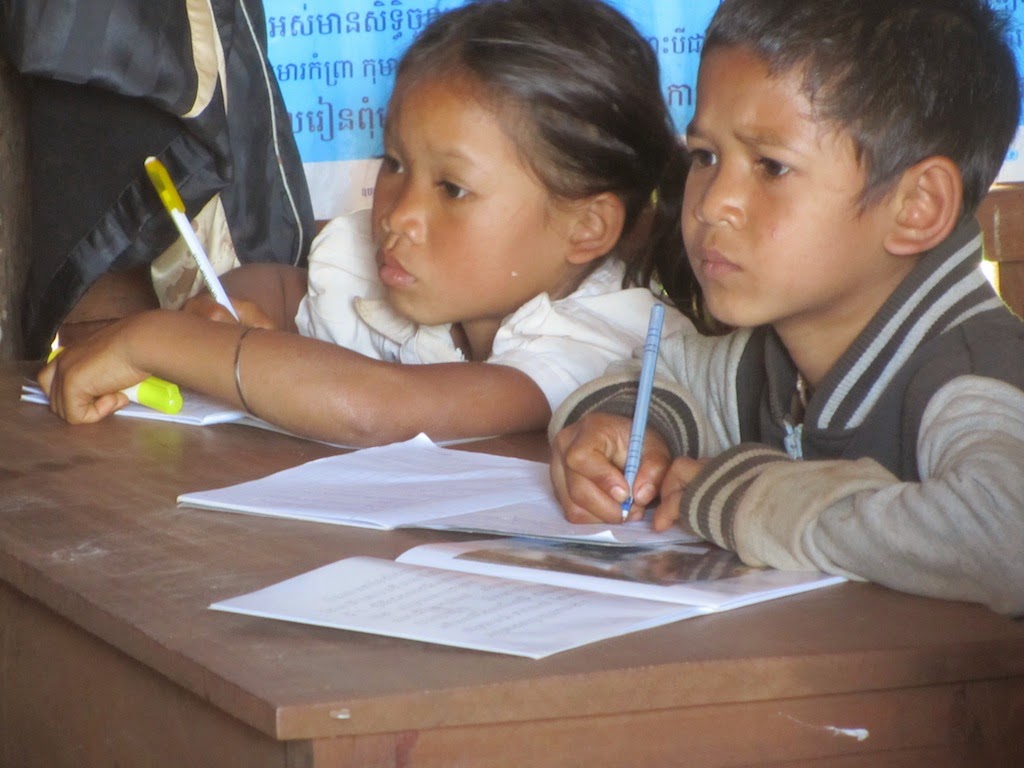
Bunong Children taught in their mother language - PoTil Village School
If students “have only a certificate that has no quality, it wouldn’t lead to a better job,” Mr. Chuon Naron said. The
ministry is also tackling issues such as children in rural areas living
too far from high schools, which pushes up the dropout rate, he said.Secondary
education rates in Cambodia remain dismal. The country saw a decrease
in enrollment in secondary school—grades 7 through 9—from 21 percent to
19 percent,
Mr. Chuon Naron said.“Secondary school is not
available in all villages,” he said. “There are only about 1,200, if we
counted them. They are not even available in each commune because we
have more than 1,600 communes.” Just 55 percent of secondary-school aged children attend school, compared to 98 percent at primary level, he added. “The
students need to travel long distances in order to study at high
school,”
More Bunong children attend school today - PouTang Village School
Mr. Chuon Naron said, leading many to drop out of school to
work. “It is a choice of each person, but what we want to
strengthen the quality in order to allow them to start a professional
career after they finish and find a good job and have better pay,” Mr.
Chuon Naron said.
The number of high school buildings has
increased in the last two years from 500 to 600, but school construction
remains a key element of the ministry’s agenda, Mr. Chuon Naron said. The
ministry has “built more school buildings all over the country,
especially along the borders and places that face more challenges in
their goal of locating schools closer to people’s houses,” he said.
During
his tour of the provinces last year, Prime Minister Hun Sen promised to
build 368 new school buildings and renovate another 27 of Cambodia’s
103,886 public and private buildings, he added.
Mr. Chuon Naron
said the ministry had also aimed to motivate educators by doubling
teachers’ salaries over the past few years. Teacher salaries have
already increased this year to 950,000 riel a month, or about $237, and
the ministry will raise salaries again on April 1, he said.
Bunong Students 'baby sitting' their siblings during school hours - PoCh'ryChang Village School


 "Happy birthday maman;


 As for work, I thoroughly
enjoy working together with staffs, MPs and my class. I have an open door policy where my students
come and go as they please. Some have
early morning commitments but still manage to attend my class. When I prepare for the next day, some students
will pop in to ask if they can help and or simply hang out! I love my students – they’re so humble and
hungry to learn.