Sunday, 28 September 2014

Pchum Ben


a religious festival
In August we went to Malaysia for a holiday to escape the wet season (an account of our trip will be mentioned at a later date).  On our return there was a heavy downpour in Phnom Penh and the streets were flooded.  We were soon greeted with a reminder of why we had left.  At the airport we had quickly grabbed a Tuk Tuk attempting to stay dry on our way to the guesthouse.  However, there were people on motorbikes that were drenched and others were wading through the streets with water up to their knees.  By dinnertime the plugged drainage system had somewhat cleared and the roads were nearly back to normal to walk the streets while avoiding the garbage that had accumulated on the streets from sewers during the downpour.

Back to Mondolkiri the clinic/house next door (that took a year to build) was completed.  The landlady had moved her petite maternity clinic in her new house and  was now ready for normal business.

On our return we were faced with the fact that our landlord/lady told us that they wanted to raise the rent, despite the contract we had made for a fixed time here.  They rational:  ‘You have an extra person living with you (that’s Kevin) and we should raise the rent’ was the analogy they gave us.   As soon as they realized that we were serious at looking for other housing they quickly changed their minds and became our friends again, giving us food, inviting us to the Watt and for a meal.

We had also arrived at the beginning of Pchum Ben.  The local Watt was in full swing with chiming music and Monks chanting the Sutra’s in the background.  This seemed very fitting for this particular occasion that began at the wake of dawn (4 to 11 o’clock).   Pchum Ben is a Cambodian religious festival that lasts 15 days leading up to a 3-day national holiday.  This is a time for Cambodians to commemorate their ancestors of up to 7 generations by cooking meals for monks and making offerings to the "ghost" of deceased relatives. It is also known as "Ancestor's Day".  During the 3-day national holiday, religious rituals were held each day at the local Watt and everyone brought food-offerings to the Pagoda.  Food was mainly composed of rice, greens, and an abundance of fruits.  The end of the mantras gave rise to a different sound, to the sound of birds’ chirping  whilst building nests for their young.

This is the second year that we have experienced Pchum Ben.  Last year at the end of September 2013, we were at the tail end of our ICT and we stayed in Kep for the week.  This year we stayed in the beautiful hills of Mondolkiri to visit the Watt, have a meal with our landlord/landlady and to invite our little VSO group to join us for dinner one evening. By the way 2 more new VSO people have arrived and now we are 5.

Now that the festival is over, we have entered another cycle of another great year in Mondolkiri.   The monsoon season is currently coming to an end and the dogs are yelping louder than ever.  They are getting ready for mating.  The weather is becoming dryer each day. The illegal logging trucks are back at full speed.  We’re now getting beautiful sunsets, which we missed during the rainy season.  And, before long there will be bomb fires on every corner of town.

In terms of work, back to school programme starts November 1, 2014 due to the anti corruption exam that took place last July. 2014.   Only 25% of high school students passed while last year 86% passed.   Another set of exams has now been scheduled for October 13, 2014 throughout Cambodia to give high school students a second chance to rewrite their exams.    Kevin and I have been busy conducting a workshop together; preparing for the School Enrollment Campaign with my Khmer and VSO colleagues and arranging Annual Partnership Review for us VSO Education Sector.  Time has indeed passed quickly for us and I’m afraid before we know it time will fly faster than ever …

On that note, Kevin and I are spending our 35th anniversary at Cullum’s place this evening for a yummy hamburger and tasty fries.

Last but not least, Esther will be coming to town for a visit from Australia

More later …

Wednesday, 3 September 2014

Expect the unexpected


There is no such thing as a typical day…
We’ve now been in Cambodia exactly one year today and an incredible year it’s been!

I remember our almost 2 hour Skype interview with a VSO staff in Cambodia and chatted mainly about travels, education, general life experience to the life in Cambodia that was soon to begin.   Our interviewer had also referred us to a ‘well-seasoned’ VSO couple who forewarned us that ‘there is no such thing as a typical day and instead -  to expect the unexpected…  ‘  

Once in Cambodia we spent 4 weeks in Phnom Penh for In-country Training with a fun group of people.   We quickly got used to the insane traffic, horn blowing, noise for the sake of noise, rules that no one cared to follow and  that no one gets upset at each other when a motor gets in the way of another.

Before we knew it we were heading to our placement destination.  The beautiful hills of Mondolkiri!  A colleague, Karen compared the hills of Mondolkiri with Wales – green and lush at least during the wet season.  During the dry season the landscape transforms itself to a red plume of dust with a multitude of bush fires spread out on side roads and in villages where I work.

Kevin and I arrived in Mondolkiri at the tail end of the avocado season – the tail end of the monsoon season, in early October 2013, (though it felt at the time that the rainy season was never going to end).  By November the rain stopped and the wet saffron red clay was replaced by a powdery dust.  On the way to the villages by motor bike, a combination of high winds with heavy trucks created clouds of dust that blew on our face, mouth and nose and crept into every part of our body, permanently staining our skin and clothes.  Back on the ranch  the red fine dust took on a life of its own finding its way to anything to the touch: furniture,  the crevices of our laptop keys to  wooden floors (our landlady soon came to the rescue with a mop in hand to give us a ‘floor washing’ demonstration). 
I was welcomed with a Khmer/English dictionary
On our arrival to our placement we were very excited and my adrenaline ran high for quite some months.   During the transitional stages of getting settled, we found a house within a week of being here. Kevin quickly found work with 3 different NGO’s to teach English to the staff.  As for me, I hired a VA a week after we arrived, met some very important people in the education sector such as my Khmer colleagues who welcomed me with open arms – they were more than helpful.  Each day, either my Khmer partner or one of our Khmer colleagues took me on many expeditions to meet teachers in the village schools to observe classes in action, exchange ideas, listen to what the teachers have to say and to be able to assist and support them in any way we can.   My Khmer colleagues work hard each day to make things happen to help improve the quality of teaching, to reach every student and more …  

Throughout the course of the year there have been successes and milestones.   More money is spent on education and an end to corruption is finally coming to light.  For the first time, earlier this year, teachers opened their own personal bank accounts.  They now receive direct payment from the government as a result from a two year research, campaigning and lobbying (credited to a group of NGO’s, VSO/Cuso and the government);  potential Bunong in-service teachers graduated from Teachers’ College in Stung Treng and returned to their home villages in Mondolkiri to teach; more girls are staying in school; some schools have become a model school for others; corruption-free grade 12 exams are now strictly regulated by the government. As a result only 25% of grade 12 students passed compared to the 86 % that passed last year (you can read more about it in the ‘Cambodia Daily’).   As for the challenges, teachers continue to be absent from school.  In the villages, teachers work on the farm, have family commitment and spend time working at other jobs to make ends meet due to low teaching wages.  As a result, teachers spend limited time preparing and delivering a child-centered curriculum; Schedules, meetings, sudden change of plans are given without notice – sometimes when I arrive at the village school teachers tell me that they’ve been called to yet another ‘unannounced’ meeting; Children have language barriers; some bilingual/trilingual schools speak Bunong, Cham and Khmer.  Teachers do not speak either Bunong or Cham.  Classrooms are poorly maintained.  Lack of good teaching practice, limited professional development support, limited teaching resources is apparent.

My VSO colleague was right   ‘there is no such thing as a typical day…’ every day is a different day.  It is how we face those challenges that count. 

Here on the home front, I think that we are slowly adapting to their Cambodian ways.  We are often invited by our landlord/lady to join them and their friends for a meal and a beer.  We are always happy to accept!  When locals (from other places in Cambodia) ask us where we come from, Kevin has a set answer and proudly tells them ‘We’re from Canada, but we live in Cambodia’.  
Fresh cassava left in the sun to dry
Furthermore, we’ve now become more familiar with the tropical fruits, vegetables and lush vegetation that appear at different times of the year.  Some of the fruit trees even grow in our own backyard:  papaya, passion fruit, guava, rambutan, mangosteen, jackfruit and the ‘smelly’ durian that’s delicious to eat!   It is soon the cassava harvest and the side roads to the villages will once again be lined with white vegetables drying in the sun.  The indigenous people – the Bunong people bring their crop from the fields to the side of the road where they and their little apprentices (their children) peel, dry and prepare the vegetables for shipment.
Awesome teddy bear street pajamas

Added to our Cambodian lifestyle, we now ride our motorbikes with flip-flops (I now wear my sandals ‘that soon fell apart from the rain and were re-sewn twice’ in Phnom Penh), as a result our feet are permanently stained in red.  Recently a colleague and I bought a colourful bright pair of these awesome ‘street’ pajamas that the women wear to the market and even to work.  We wore them to work the day we bought them except that they were no one to show them off too …  In terms of speaking Khmer – well that’s another story.  

Over this past ‘incredible’ year we’ve had an opportunity to meet and talk to people that we wouldn’t otherwise had the chance to encounter –  to hear their stories - their dreams and their hopes.  Such as the late Dara, our VSO Khmer teacher who was sm art, witty and fun.  He had a way of making us laugh when he knew we had had enough with our Khmer lesson.  Dara sadly passed away a month today.

And yes, we are still going strong despite the drastic change of the two seasons and even to think that we’ve experienced two winters.  The first winter came in December and the second in July when it turned cold because of the endless rain and dark clouds that keep temperatures low.   What counts are the people that continue to teach us and direct us with the countless things that we are yet to discover...

More later …  

Sunday, 20 July 2014

Ah the sounds of la vie quotienne here in Mondolkiri

Time goes quickly.  It’s hard to believe that Kevin and I have been here for almost 10 months.   It means that we’re still having fun … working out in the field, organizing workshops, taking trips to Vietnam, Kep, Kratie and lately, taking several trips to Phnom Penh trying to get my laptop (that crashed recently) fixed, celebrating, organizing induction plans for new VSO volunteers (while sadly biding farewell to others)…   Not to mention the sounds of la vie quotidienne from our little community down below who are still working on the new house that began to take shape a while ago.   Though we’ve had many activities on the go, I have no real excuse for not writing.  My motto is to procrastinate until guilt creeps in to tell me that it’s time to put pen to paper.

For the Khmer New Year, Kevin and I spent a week  (via Kep) in Ho Chi Minh City, Vietnam.  Though we were warned that Saigon would be like a ‘zoo’, we welcomed it with open arms after camping for nearly 10 months.   It was indeed a nice break for us.   On the way to Ho Chi Minh, we spent the weekend in Kep.  Kep is known as the ‘little French Riviera’ of Cambodia.  It’s a popular place for tourists and it is the place to relax, sleep and soak up the sun on a sleepy afternoon.  The best part of the day is taking a stroll to the sailing club for a drink and to end up at the crab market to watch the sunset while eating crab slathered in Kempot pepper sauce. 

As for work, we conducted several workshops to build the capacity of State/community teachers, directors and cluster chiefs in education: reading, math, science, social justice and inclusion; Healthy living, some English (here  and there) in the villages, in Sen Monorom town and in Kratié, our neighbouring province.  In late June 2014, VSO Educators from the 3 northern Provinces (Stung Treng; Kratie, Ratanakiri) joined us VSO educators here in Moldolkiri Province to  discuss and to possibly link a VSO English programme to the new Cambodian student book that was published late last year - November 2013 and was put into action in some village schools here in Mondolkiri province in January 2014.  A follow-up of the workshop was done in Kratié where teachers were given the opportunity to put into practice what they had learned!

Now that the rainy season is here I’ve been staying in the villages for longer periods of time to work with teachers and directors.  Sometimes the teachers come to school and other times they are out in their farms harvesting mung beans, planting cassava, or working in rice fields.   Seasonal food production work is critical to the village people and salvaging their crop will always be a priority for them.  For example, if the village people don’t harvest the beans before the rain comes they will spoil.   So my VA and I plan our activities around the teachers’ schedule.  However, it’s good to know that when I’m in the village for several days, teachers do come to school and will let me know ahead of time when they plan to work on their farm.    


Elsewhere in Mondolkiri, on the way home (to Sen Monorom) from the villages, on one occasion, when we thought it was safe to return home from our village visits in several schools, we were caught in a heavy  rain storm and got drenched.  Rutted muddy roads turned to rivers, high cliffs on the outskirts of Buch'ri Commune converted to a cascade  that contributed to rivers, and, my camera got soaked.  I was able to salvage some of my photos, however, I lost them all when my laptop crashed just recently.

On the positive side, in courtesy of Kevin and our daughter Tralore, I had a month long birthday celebration at home and in Phnom Penh.  During one of our many trips to Phnom Penh to find out the cause of my laptop, why the operation system failed and crashed, we took a river cruise along the river.    We noticed that the direction of the Tonlé Sap flowed backward because of the high waters of the Mekong.

More later … promise!

photos will be posted at a later date.

Sunday, 4 May 2014

A time of change …

The dry season is over.  It’s early May and the rains have arrived. 

Each day lightning with thunderstorms heralds the rain and each day the rain last longer turning the ‘saffron’ dirt roads into streams and rivers of mud becoming treacherous to ride on …  

So now I get up at 5 a.m.  In the dark.  In a vain attempt to beat the rain, my VA and I rush to the villages to deliver workshops, but invariably return home drenched and splattered with mud … I have adopted a large bamboo stick as my travelling companion to wade through the muddy waters when I have to dismount the motorbike while Savy pushes the motorbike up and down the muddy hills.

With the rains, surrounding forest has come alive with lush green foliage;  together with deafening sounds of frogs, cicadas and other unknown ‘electrical’ insects.  Also, swarms of cream yellow butterflies drift by during the day and at night we are invaded by thousands of ‘May Pleans’.

‘May Pleans’ - Rain Insects, also known as: large 4 wing-flying ants appear at night. After a heavy rain thousands of ‘May Pleans’ dance around night-lights shedding their wings in the course of the night littering the grounds by morning.   Fried ‘May Pleans’ are a local delicacy which I’m told taste like bacon bits. 

Of course this time of the year ‘May Pleans’ are a real feast for geckos.  Every evening, around 7, our friendly gecko positions himself on the awning with his head stuck out ready to attack.  First, he lets flying insects swirl around him and then he devours them whole once they are close to his bite.

Farewell to VSO volunteers
With the changing of the season, there’s a change of VSO Volunteers.  As I speak a swarm of VSO volunteers are getting ready to leave Cambodia.  Gemma has just left.  Followed by Tracy, Karen.  Soon Yves, Zeneida, Sabrina will be leaving …

Last night we had a party for my colleague whom we met at our pre-departure training in Ottawa.   While Karen and I prepared for the party, the heavens opened, the house began to leak and Kevin began to ‘madly’ mop up the floors.  

During the downpour the power went out.  The pizza guy called to say that the pizzas were ‘ready’, but not cooked due to power failure.   So for a while we sat on the verandah with romantic lit candles, wine, beer and food until magically the power returned just as our guest arrived with the pizzas at that!   In the end, everything fell into place, despite the constant downpour that continued throughout the evening.

It’s now 2 in the afternoon.  Dark clouds are rolling in quickly.  Another burst of torrential rainfall is about to start.  Kevin and I are getting ready to meet the VSO gang at Café Pkhar for one last farewell ….


More later ...

Photos will be posted at a later date

Saturday, 29 March 2014

One day in the life of … Hello my name is …


Monday morning, I asked my Line Manager for the key to the POE Resource Centre. This was to prepare for the Saturday BEL workshop.  With a smile he replied ‘Do not worry...  You will get the key by Thursday or Friday of this week’.   Pointing to the other POE building he said,  ‘Find the ‘cheerful housekeeper’ and she will give you the key’. 

By Friday morning, I became a little anxious.  There was no sign of the  ‘cheerful housekeeper’ who throughout the week had promised me the key.   Finally, she appeared with a tangle of keys wired together and dared me to try and separate the one I needed.   I sat on the steps outside our office and like everyone else before me, I did a few twists and turns to separate the keys when  ‘Voilà’ – Success!  

Once I had the key, there was a mad scramble to get the room prepared.   Mop in hand and bucket in the other, together, Kevin my husband, Savy my translator, the ‘cheerful housekeeper’ and I, we began to clean the room. 
Preparing for the workshop
We opened the windows, washed the floors; dusted walls, tables, chairs; placed chairs in a horseshoe shape ...  I even washed the garbage container and positioned it at the entrance of the door as a reminder to keep the room clean.  Finally, it was!      

Unfortunately, the toilets were not functional, apparently, the man who had authorized the water supply was in Phnom Penh.   What the participants did remains a mystery, although the POE complex has many walls to hide.

In total 27 Directors and teachers attended the workshop.  They came from 6 different districts in Mondol Kiri Province, some traveling up to 135 km by motorbike on rutted dusty roads.    At first they appeared to be just as nervous as me because of their limited English.   However, they went away with a few simple English expressions such as:  ‘Hello my name is …  I am from …’

Posting survey charts
Creating survey charts
In the end, the workshop came altogether.   
Kevin and Savy had created charts with questions for the participants to respond to and taped them to the walls.   
We had enough BEL materials for all participants.  The water and snack -banana fritters and sandwiches arrived as planned.
Picking a partner ...
Most importantly, the teachers had joined in most, if not all of the BEL
activities, contributed to discussions and had fun in the process.


Hello my name is … Part 2.   
Savy - midwife and super lady ...
Back on the ranch, the highlight of the day
was to discover the wail of a new born baby that had newly arrived in our little community.   Savy, our landlady and midwife (not to be confused with Savy my VA), had just delivered a baby in her little shed below our house.   Though she looked a little wary, in her English she said, ‘baby’ -  ‘proh’.  I answered with a nod, ‘baby boy’.   She repeated, ‘baby boy’.  And we never did know his name.

More later ...

Friday, 14 March 2014

Follow-up to an ‘Unusual’ Day - ‘There will be ‘NO’ middle-man’


Mondolkiri Province is a large and sparsely populated rural Province that borders Vietnam.   It’s home to the Bunong people – the indigenous people who have lived here for many years.  Some of the Bunong people practice their traditional semi nomadic lifestyle living off the forest through hunting, collecting fruits and plants.

However, more and more Bunongs have chosen a different lifestyle.   They have settled and established small communes with smallholdings producing rice, vegetables and life stock. 

Usually, these communes have a number of small schools consisting of 2 to 6 classrooms and 50 to 200 students in each village.  (Buchiri Commune for instance has 5 villages with 5 different schools).  Students are taught from grades 1 to 6.   However, Student attendance drops off greatly at the later grade levels because children are required to either help collect produce from the forest or grow produce on the farm.  Teachers in these schools are typically Bunong and have a grade 9 Education.   
  
Teachers in these remote schools have been dependent on receiving their salary from the DOE via the POE.  Now very recently the government has decided that teachers will be paid their salary directly into their own personal bank account.   In early February 2014 ACLEDA bank staff were busy in the schools opening bank accounts for the teachers.

Throughout Mondolkiri Province, teachers will now be able to travel to Sen Monorom or to ACLEDA ‘apartment’ banks to withdraw their money.


February 19, 2014, Teachers were interviewed and were asked how they felt about having their own bank account.   See below answers from teachers:

Are you excited that you now have a bank account?
“Yes I’m excited to have a new bank account.   I can get my salary anytime I want.  It is much easier to get my salary from the bank”.   Krob Khna


“Yes, I’m happy to have a bank account”.
“In fact, I’m very excited because the State –the government has made it mandatory for all teachers to open a bank account to secure their money” . 
Sadin Sreymao

Is having a bank account important for you?  Why?
“Yes, because when I go to the DOE in Bousra to collect  my money, I’m never sure if I’m going to receive  it.  The DOE doesn’t always have my salary.  I have to wait many months for the DOE in Bousra to pay me because the DOE didn’t collect  my salary from the POE in Sen Monorom”. 

“This is a very long process and during the monsoon season we are not able to reach Bousra because the roads are not good to travel”.
 
“Now I can go directly to Sen Monorom and collect my money from the bank”.

“This is how the system works: 
-       The POE goes to the Provincial Bank in Sen Monorom to take the money out.
     The POE contacts the DOE in Bousra to let him know that the teachers’ salary is at his office.
The DOE goes to the POE in Sen Monorom to collect the teachers’ salary.
The DOE contacts each school directors to inform the teachers that the money is waiting for them in Bousra.”  Kroye Chet                                                                

Does it make you feel respected by your family, friends, community  now that you have a bank account?
“Yes!  My family, my parents and my community are so proud that I now have a new ACLEDA account.  It gives me a sense of pride”. 
Sarun Seyen


“Yes, I feel respected more than before because my family told me that the DOE will not ‘cut’ my money anymore.   My family is very happy for me that I will have a bank account.  They will not worry about me anymore.  They will know that my salary is in the bank and will not be ‘cut’ [and will be secured] by the bank”.    Neyso Kon

“Yes. My friends,  my family, my community ask me ‘where are you going?’  I tell them,  ‘I’m going to ACLEDA bank to get money’.  People respect me because of this”. 
Yun  Sokhun


Do you expect to receive a full salary?  How will you know? 
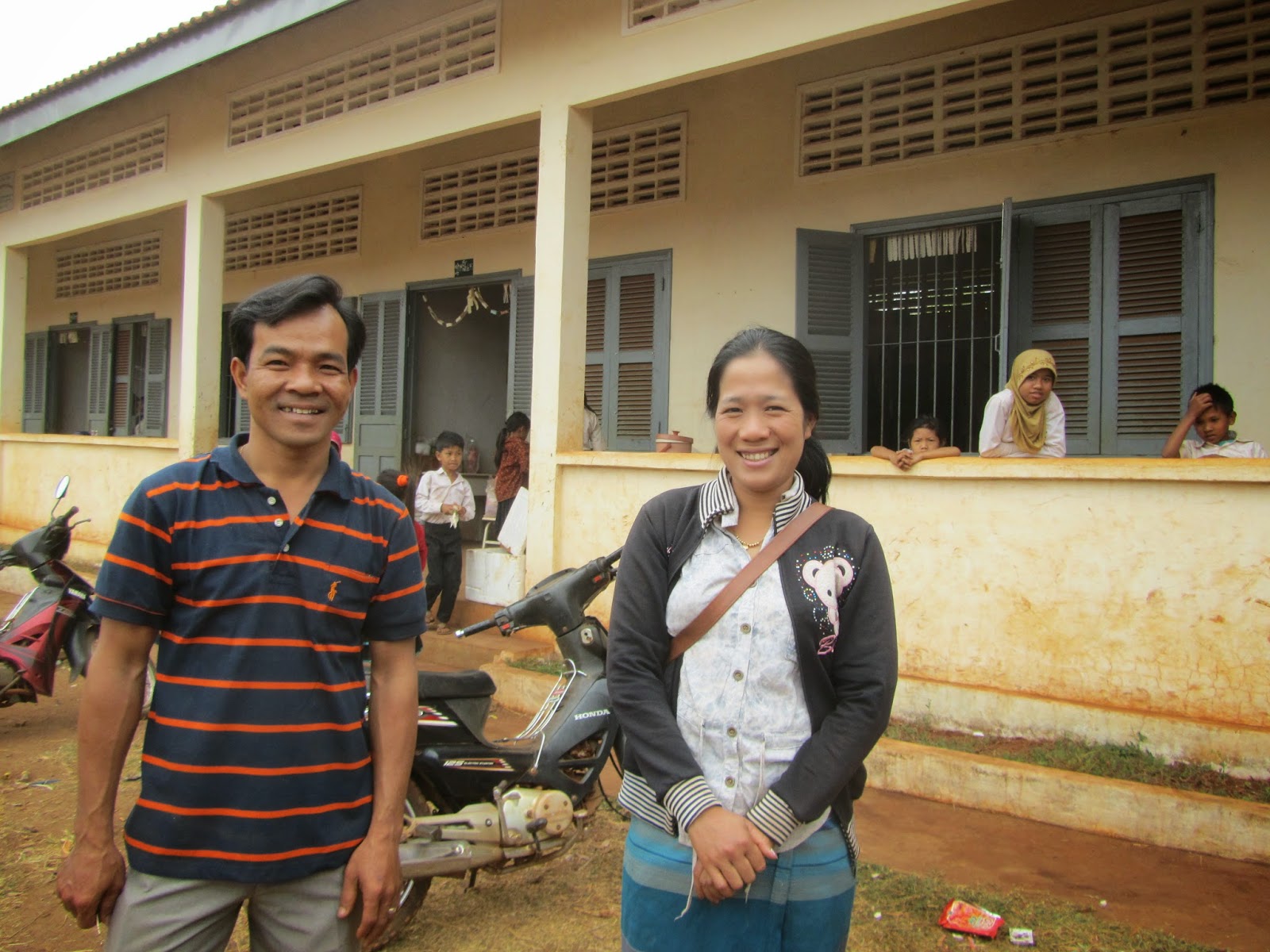
“When I get my salary at the DOE in Boursra, there is a list of names and salaries posted on the wall.    Now, the government will put our  money directly in our bank account. 
                  There will be ‘NO’ middle man”. 
Tun Oeung and Khay Tola

“Yes.  I listen to the radio.  The government announced that all teachers throughout Cambodia will receive a ‘full’ salary.  No one can ‘cut’ their salary”.
Sarun Seyen


What are the benefits to you of having a bank account?
 “When my money is in the bank it will grow”.
 “I know about interest because I read the ACLEDA document the bank people gave me.  I read the bank document  ‘very carefully’ and I found out that my money can grow”.

“When I keep my money in the bank it has ‘security’ and I can also get interest.  I heard it from my sister.  My sister has a bank account"           Neyso Kon
 
“ When I go to my homeland ‘Tae Kaev Province’  I can withdraw my money from there also”.   
Yun  Sokhun


“There is benefit for me.  I spend less money to travel to Sen Monorom.   Sometimes we have to call the DOE in Boursra to ask ‘where are you?’   ‘Sometimes they work and sometimes they don’t work’. 
With the bank, I know I can count on my money to be there.  I don’t have to wait for anyone to give me my salary”.   
“My salary is more safe and secure.  I will spend less money, less time for travel”.        Yoy Bora and Roeun Len
Where will you withdraw your money from?
“Sen Monorom”.   “It will be much easier than travelling to Boursra.  The road condition to Bousra is treacherous. It’s rutted and dusty in the dry season and slippery during the monsoon season”.
Khay Tola

Teachers' bank account will be opened  “April 1st , 2014”.  Salaries will be deposited monthly.

Savy my VA was responsible in translating the interview with the teachers.
“I think that it’s good for the teachers to have a bank account because they can spend less time, and less money to get their salary.  Teachers can be more independent and if they want to save money and earn interest then they can”.   Let Savy

*  February 19, 2014       Interview Questions/Answers re: Opening a Bank Account    
*POE = Provincial Office of Education     *DOE = District  Office of Education   *Photos were taken with the teachers/directors permission to up load on any website or to be printed in newspapers or news letters.

More later ...