Wednesday, 30 September 2015

Revolving doors

September zipped by …  where? I’m not sure.

Avocado season is now over and has been replaced by cassava, passion fruit  ‘how di how’ clams.

September was an unusual month with comfortable warm weather.  Though, it’s officially the rainy season, rain and humidity sporadically crept in.  Thon, a local Bunong, one of Kevin’s English student, told us that the 'lack of rainfall was attributed to climate change caused by local deforestation,’ one of the culprit for illegal logging.

In early September, the grade 12 exams took place throughout Cambodia.  56% passed!  In Mondolkiri province, 80% passed, the highest province to pass the exams in Cambodia.  A remarkable turn around from last year’s results!   Savy, my translator mentioned that with this high number of students who passed nation wide, that there was indeed some cheating done.   In spite of this, as a teacher himself, Savy felt that it wasn’t the responsibility of the government to do /pay for a retest, but it was the teachers’ responsibility to do a better job with their teaching.  He added, that the ministry is now stepping up to the plate to ensure that teachers are being  properly trained  to deliver a  better  teaching curriculum.

It's been a month with numerous training workshops that took place both at the education complex, the villages and out of town: inclusion, multilingual education, library management, love of reading, what does it mean to be a teacher? and more.   We plan to do follow-ups from November on, after the school enrollment campaign in October, and, when school opens again.

Elsewhere in Sen Monorom, we’ve noticed that a number of street signs are cropping up throughout town, yet, there are still no streetlights in site.   Consequently, motorbike drivers continue to insanely ride in different directions, ride in close proximity, nearly colliding with each other.  No one blows their horn at each other and everyone seems to be cool about it.   Ironically, however, on the air strip, on the way to the villages, a new no horn sign was recently put up for the purpose of the heavy truck drivers who have a tendency to blow their horns at anyone their pass, (motor bikers, pedestrians,) no matter what the circumstance.  In the town itself, a Honda dealership was just newly erected and  is now fully in operation, sadly spoiling the authenticity of the market scene line on the main street of town.  With modernism, unfortunately, there will always be consequences.

Other news,  recently, there’s been a revolving door of high turnover of VSO volunteers and VSO staff.   One of the  full time VSO staff member, unbeknown to the rest of us, also had a full time job with the government.   Finally, he was given an ultimatum:  VSO or the government.  He chose the latter.   As for us, since the mass wave of VSO volunteer’s departure, we’ve been rather fortunate to hook up with other NGO volunteers here in MDK.

A happening place as always on the ranch :)   Nana, the guard dog, in her excitement went completely berserk, when the landlady/ landlord returned from their trip away in Phnom Penh to get their car fixed.  Savy in her wisdom had  accidentally smashed the family car on the corner of their newly built house.   In the meantime, (whilst the landlord, Sukhon waited for his 'pride and joy’s ’ car to be fixed), Sukhon somewhat resembling ‘Inspector Cluso’, rode around town with his old beaten motor bike lol.  

Last but not least, September was an exciting month because it was our 36th anniversary and we got to celebrate it in Phnom Penh, at the end of the month, when I attended an in-service with the educator sector and met the new education manager, our 4 in two years.

More later … :)

Friday, 18 September 2015

The local 'Bunong' market

-a revolution …
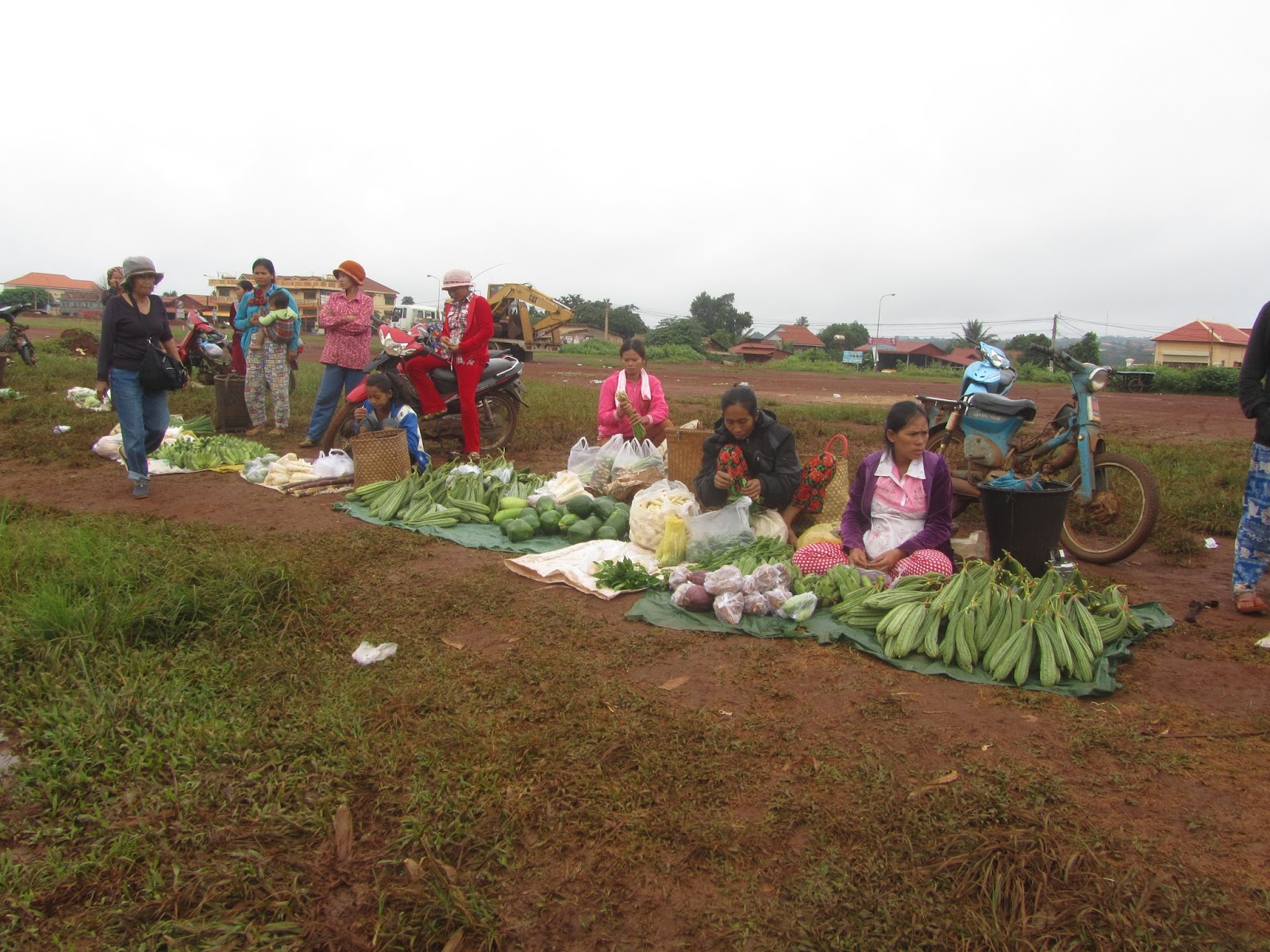
The Bunongs selling their fresh produce on the airstrip
Recently, Savy my translator told me that the Bunong people, who walk to Sen Monorom everyday to sell their fresh produce, have stopped selling them at the local market, at the ‘Bunong’s place’ that was built ‘exclusively’ for them.    

It was a place for the Bunong to sell there freshly, painstakingly, grown produce at a wholesale price to the Khmer buyers due to high demand.  It’s important to note, that the Khmer people preferred to buy the Bunong’s fresh produce from them, because not only is their produce cheap to bargain for a lower price, it is also freshly grown in Cambodia, unlike other vegetables that are grown and sold from the neighbouring countries such as Vietnam.  In turn, the wholesale buyers, the Khmer buyers, at the local market, sell the Bunong’s produce at a retail price, at a higher price.  The Bunong, aware of the situation, realized that they  too, could independently sell their own produce directly to the Khmer locals at a retail price.  As a result, they have since moved to a different location, away from the market, and have settled along the air strip to sell their goods, such as fresh sweet-scented lemon grass, sweet basil that’s used in traditional Cambodian cuisine and much more.   

A Bunong family walking to the airstrip to join the others
Ironically, elsewhere in Cambodia, although 80% of the country relies on agriculture, as a livelihood, poor farming infrastructure and competitive prices from neighbouring countries are holding back local produce from dominating the domestic agricultural market in Cambodia.  

There is good news however.  The Ministry of Commerce with improved farming infrastructure in mind,  with the help of several NGO programmes that were put in place in specific areas of Cambodia, are in the process of training farmers in organic production methods to support the nation’s farmers.   This is to encourage local famers to grow a variety of produce in order to enhance the agrarian nation’s initiatives.  Local attitude, as a result, is slowly changing, and more and more retail buyers are buying directly from the Cambodian farmers supporting their livelihood and their families.   In the case of the Bunong farmers, not only have they become an independent commercial industry in their own right, they can now begin to ‘comfortably’ support their families by what they grow and sell ‘freely’.  

More later :)

Thursday, 3 September 2015

Two years today

An incredible two years it's been! 
A celebration for Kevin and I is indeed in order!  September is an exciting month for us, because it marks the beginning of our third year here in the Kingdom of Cambodia. What’s more, it is also our 36th wedding anniversary.
In the days leading up to our placement in Cambodia, swamped with this and that….., I took some time away to do some reflection, to share the news with family and friends, in particular with my special friend Wendelin.   Over lunch, we talked about everything under the sun.  We also talked about the uncertainty that I felt , having had limited knowledge of what we were about to embark on;   the mixed feelings of working and living in a different country for a long period of time. Further, undecided to create a blog, I wanted to find out from Wendelin what she thought of the idea, about us, Kevin and I, sharing a glimpse of  ‘la vie quotidienne’,   sharing a glimpse of our lives with family and friends, during our time away whilst living and working in Cambodia?  After much discussion, Kevin and I went ahead and uploaded our first post.   Now, it’s hard to believe, that two years today has passed with so many experiences, with so many stories to tell...
Lunch with Wendelin
I remember reading from the lonely planet that our placement, Mondolkiri Province, had  been portrayed, as the ‘Wild West’.  Others had claimed Mondolikiri to be in the middle of nowhere, in the jungle, far from civilization and more. ’   Not any more!  When we first arrived, we were pleasantly surprised to find that the road to Mondolkiri, from Phnom Penh, is  in fact exceptionally good and takes a mere 5 ½  hours by minivan– a far cry from what was described in various issues that we had previously read. The road to Sen Monorom was completed in 2010.  As a result, Sen Monorom Town, the capital city of MDK, now has a population of 10,000 people and it's growing :)
In terms of 'jungles' in Mondolkiri Province, there are still large areas of  dense forests to carpeted lush rolling open grassland, preserved parks,  hidden waterfalls that have been left untouched.  Sadly however, other parts of Mondolkiri have been cleared, replaced with rubber trees, palm oil trees and more by developers from other Asian countries, deals that were made between them, developers, and the Cambodian government.   What’s more, unbeknown to the locals, Cambodian’s luscious scenery is in the midst of being spoilt, damaged with garbage, oil spills, plastic bags, water bottles, containers that are strewn everywhere: on roads, floating around rivers  and more … 
Fishing in the Sen Monorom Lake
Throughout the course of our  2nd year  here, once again there have been successes and milestones:  Corruption-free grade 12 exams  continue to be strictly regulated by the government.  Results of this year’s grade 12 exams will be published by the end of this month;  Roads throughout Cambodia, throughout Mondolkiri and on the way out to villages are improving. Sen Monorom town has grown considerably.  Many buildings are erected bringing more jobs to the locals to support this province;  More Cambodian writers and illustrators are writing children’s books, novels, journals for the Cambodian public to read and to enjoy.  That is wonderful news! The water supply in the education complex’s bathroom is ‘officially’ available and can now be used.  No more hiding behind the bushes. Lol  However,  there have been times that the boarding -school units, at the back of the education complex, who share the large water tank with them have been hard pushed to extract water for their normal use.
As for education, the Minister of Education announced that a new ‘5 -year strategic education plan’ had been put in place to help improve the quality of teaching throughout Cambodia . He also announced that: 'more money will be spent on education; teachers’ salaries are expected to increase over the period of 5 years; multilingual education will continue to be implemented with a focus on ‘minority inclusion’ in the two main northern eastern domains – Rattanakiri and Mondolkiri provinces.'
Other highlights, earlier in the year, the education complex had ongoing football matches between districts and communes.  Both the girls and the boys' teams from the 5 districts in MDK had moments of their winning glory.  Further,  last July, Cambodia had won 15 medals in multisports events at the 28th SEA games Singapore 2015.   In 2023, Cambodia is gearing up to host the games here in their own country.  More enlightening, for the first time, health education will become mandatory and become part of the ‘3 Thursdays teaching and learning subject’ during the next school year.
What are the challenges?   Teachers  and students continue to be absent from school.  As mentioned before, in the villages where I work, teachers work on the farm, have family commitment and spend time working at other jobs to make ends meet due to low teaching wages.  As a result, teachers spend limited time preparing, delivering a child-centered curriculum and more.   Lack of good teaching practice, limited professional development support, limited-teaching resources continue to be apparent.    

Recently, the week before school closed, a group of MoEYS educators from Phnom Penh  came to the education complex to assess progress made in the schools here in MDK.  They were also  invited to visit some of the ‘better’ schools in the villages for the day.  Except, as per usual, they omitted to visit those that are in desperate need of help in the area of providing better infrastructure, better resources and much more.   
Rebuilding on education has been an enormous task
Understandably so, rebuilding education in Cambodia has been an enormous task with its challenges - however, it is indeed steady and getting better with much funding from  international investments and the Ministry of Education's new proposed ‘5 -year strategic education plan’.…  Further, my Khmer/Bunong colleagues at work continue to prod on, to work hard each day to make things happen to help improve the quality of teaching, to reach every student for a better tomorrow … 

As a long-term volunteer,  my job is to work along side teachers and school directors to strengthen education. Though I was warned that my work with the people would be a major undertaking, in fact it has been a ‘titanic’ task.  The prerequisite for this job is patience, determination, resilience, flexibility, and a sense of humour when faced with problems, obstacles and frustrating circumstances.
So what’s the best thing about volunteering, we were asked, over and over again? Connecting through the hearts, the minds of the people; feeling part of the community in an age where neighbours in other parts of the world have little time for each other; watching smiling children, the builders of the future, explore endless possibilities through play and work - realizing that there is hope at the end of the tunnel; watching them clap with delight when a classmate give an answer;  having fun and keeping our minds active at the same time - staying connected with the world around us; being endlessly entertained by new and unfamiliar situations - in short, there's never been a dull moment; learning from the locals.   We're lucky to be here and yes, we look forward to experiencing yet another incredible year!  
More later … :)

Saturday, 29 August 2015

Regrouping

Meet and greet
August, like every other month, came and went in the blink of an eye … 

At Robert and Minette's for a delicious dinner
August was a month where we went to several dinner parties: at our landlords, three times, to meet and greet some of the new VSO – ICS leaders who now live below us and ,to bid farewell to the first group of ICS youth volunteers who worked in Education for 10 weeks, at Callums to celebrate the opening of his new little restaurant, and at Rob and Minette’s homes where we had yummy roast chicken with olives, roasted potatoes, several lemongrass mojitos and much more….    We also met up with the new VSO health volunteer, who has taken up the ‘Leaving Hygienically’ initiative, (in some targeted schools, and of course, will continue to collaborate with the communities, that two previous health volunteers worked at) for another year.  In terms of settling in our surroundings, I must say, that we have indeed settled in comfortably and quickly, regrouping with the Khmer, Expat communities and colleagues at work.    

Other news, on our arrival, we learned that Cambodia had won 15 medals at the Southeast Asia Games.  In 2023, Cambodia is gearing up to host the games here in their own country.  That is wonderful news!   In terms of health education in Cambodia, at the moment there is little to non in the elementary public schools, unless students are in private schools.  I remember as a child, how I dreaded the days I had to partake in phys.  Ed.   I didn’t realize then, how lucky I was, that I could take  a variety of sports at school.  What’s more, how  privilege  I was to complain about it.   However, more and more schools are seeing the value of health education and as a result, the ministry of education is  seriously thinking of doing something about it – they are thinking of  adding physical education in the extra curriculum activities that will be available every Thursday as part of the ‘teaching and learning subject’ during the next school year.   And here’s the proof – now Cambodia is taking small steps in the Cambodian sports world.

A real bargain:  On a different note, reversing the meter back to the early part of August.  Before we headed off to Mondolkiri, I took the liberty of getting my watch fixed, along with getting a new battery.  Off course, as to be expected, we were pointed to one of the many stalls outside the New Market in Phnom Penh to have it seen to.  The repairman casually took it apart, meticulously cleaned each piece, (all the while inspecting it and assessing the problem), continued to clean every bit of the watch with care, taking all the ‘red’ crud out that had accumulated over time between the rims of the watch, before assembling it - All for $2.00!  Off course, with the battery included - a real bargain indeed!  Now I have a new watch that works - at least for now :)    Also, whilst we were in Phnom Penh, we bought a cheap and cheery toaster oven for healthier delicious meals.

Savy / Sukhon:  Here on the ranch, here in MDK, the landlady / landlord were thrilled to see us - all smiles, hugs, with several pats on the back to ensure that we were ‘truly’ here.  lol Once in our apartment, before we had a chance to set our bags down, settle in, unpack … ,  the landlady, Savy and her helper, both with a mop in hand,  were soon in our apartment to open doors, windows, strip sheets off our bed, to take the mosquito net down and more.   Savy, as per usual, had orchestrated a ‘fun fair event’ and ordered her 'helper'  to do this and that - to wash our bedding for us and to basically take the household chores off our hands.   Soon, the ‘frantic’ mopping strokes began!  Savy and her helper began to mop the floors whilst we attempted to unpack.  Though we both asked to help, Savy wouldn't hear of it, she continued to madly mop the floors,  shook her head (to insinuate  a NO), waved a hand in the air, repeatedly saying  'ote panahia' - no problem.  Since Savy had persisted that  she and her helper wanted to take care of the house cleaning, that we were best to leave them to it.  However, all this proved a little bit too much for Kevin, who had temporarily left the apartment to get gas for the motor bike, and, to take it for a test ride to see if it was still in good working order.  On his return, the landlord, gave us, (Kevin and I) a tour of his little farm at the back of our apartment, to show us the little wooden frame house that was in the midst of being erected on his plot of land - the farm,  all the while snatching avocados and rambutans from his trees,  insisting that we should try them, even though, they were unripe. lol.    In the 2 years, we’ve lived here, Sukhon, the landlord, had  cleverly recycled his  wood; previously from their wooden home, (now replaced by a brick /concrete house), to a shed beside the motorbike garage and now to a small wooden building that was built in one week on the little farm.   

Elsewhere in Sen Monorom,  Callum announced that a Cambodian entrepreneur  planned to take over the new  'incomplete' Sovanikiri’s Guesthouse, because as it turned out, he and his wife didn’t have the money to cover the cost of the new building.   Instead, just down the road, a short walk from his old guest house/restaurant , they have just erected a new little restaurant together with a few modest guest rooms at the back of it, using the wood from the old Sovannikiri's guesthouse to build them – recycling wood is a common theme in Cambodia. 

August was a month that the grade 12 exams were held for the week of August 24 – 27. This time around the  students were closely monitored by high school teachers from different schools in Mondolkiri Province, instead  of being monitored by a group of teachers  who, last year, came from the capital city. 

As for work, public schools here have just closed for the summer/rainy season break and reopen in November.  On the contrary in Canada, the school term has just began ...  In terms of delivering workshops, my translator Savy - (male)  and I, are in the midst of translating the primary curriculum, (recently approved by the ministry), for during the months of September and October,  a small group of teachers and I can begin to develop and add simple resources that make sense to them, to add to the primary Khmer Language curriculum.   In terms of the reading workshop, we do indeed  have a green light, the partners have agreed to stay  in line with VSO's policy.  Therefore, we will go ahead and deliver several reading workshops for both teachers and directors during the teachers’ summer break/rainy season.  

More later … :)

Friday, 14 August 2015

Khmer 101

Did we graduate?
On our return to Cambodia we were pleasantly surprised to find - as to how much Khmer we had picked up - as to how much we had learned from the people, from the community we live in. We went from saying ‘tamada tamada’ - things are fine, to simple sentences that we can finally formulate and that make sense for the Khmer people to understand…

Initially, Kevin and I carried a dictionary with us, mispronouncing every Khmer word that you can possibly imagine …   Even more troubling, the Khmer people misunderstood us, because they thought we were speaking a foreign language - English instead of Khmer.   We even went as far as creating cue cards, which we pasted around our apartment to remember the new words that we had just learned.  In short, we realized that being both in a classroom environment with our Khmer 101 instructors, the belated Dara in Phnom Penh, and with Sophek in Mondolkiri, was in fact a disservice for us!  We were indeed overloaded with too much information all at once.   What's more, although the instructors were Khmer, did their best to deliver a good program, we were still isolated with the know how of learning the  ‘true’ Khmer language.  That is, as soon as we ‘barangs’ left the classroom environment, we naturally reverted back to our familiar milieu – to   English.

However, once in our placements, once we were forced to go out into the community, the market, the villages, to interact, share the culture, breath the same air, we gradually began, became, more accustomed to their ways – progressively assimilating ourselves into the language, the culture?

Putting a spin to our little adventure on route to Mondolkiri:  half way to MDK, we met up with another minivan, with the same company that we were travelling with, who had pulled to the side of the road and motioned our van to do likewise - and to pull up behind him.  Everyone got out of both vans, ours and the van in front of us, except for us!  I suppose we weren’t paying much attention to the change of the guards, except that we ‘mindlessly’ thought everyone was taking a quick ‘washroom’ break’ out in the field.  In fact, people were exchanging vans and were asking us to leave.  Clueless, we looked at each other, looked at the people, and didn’t move, until the new driver pointed to the other van (that had stopped in front of us), for us to switch to it, and to take with us our belongings, for Mondolkiri.  Why we had mysteriously exchanged vans, we will never know.  Did we graduate from Khmer 101 – basic Khmer language instruction? – maybe...  The culture however, will inevitably take time to understand it’s many 'onion' layers.  When we think that we have understood a situation,  another new inexplicable layer is introduced. lol

More later … :)

Thursday, 6 August 2015

Living Hygienically - ម័យតាមសាលារៀន ក្នុងការរស់នៅដែលមានសុខភាពល្អ

Initially, a 3-month hygiene pilot project was introduced to reduce absenteeism because of diarrhoea caused by poor hygiene and sanitation.

The partners in Education, selected three rural village schools in Pechreda District with poor health/sanitation.   We, Socheat, a VSO health volunteer,  and I with our VA’s, visited these rural schools to meet and assess the directors and teachers for their support and ability to participate in a 3-month hygiene pilot project. 

Pou Kreng Village School in Srae Ampoum Commune, and Poutil and La Mes Village Schools in Bousra Commune were the targeted schools for the first part of this project.    Reaching these village schools on the motorbike meant driving on rutted slippery muddy roads for 10 to 20 kilometres off the paved road.  

On our arrival, we discovered that only one of the schools had a functional water supply and none had latrines.   Teachers and students talked about the lack of hygiene in their schools and the high rate of diarrhoea among the children.  Most students had experienced diarrhoea and many had stories to share about what it felt like to be sick and to miss school.   None of the students were washing their hands at any point during the day due to lack of supplies such as clean water or water supply, soap, washbasins and more.  After lengthy discussions with teachers and directors, they  appeared eager to participate in the project and already showed an understanding of the link between improved hygiene and improved health and school outcomes. 

3 months later, because we saw a great need for hygiene improvement throughout the village schools,  Socheat, my VA and I selected 3 more rural village schools:  Kumamekong, Poch’ryChang and Poch’ry Village Schools in Buchiri Commune were selected to extend the same 3-month hygiene pilot project that was previously done in Srae Ampoum and Bousra Commune.    This was as a result of the  'Holistic' Survey that directors and teachers were given earlier in the year.  They saw the needs of ''The Maslow's hierarchy of needs theory" and agreed that they wanted a Hygiene Workshop demonstration (and more) tied to the 'CFS Living Hygienically Curriculum' done in their school.
                                                           
Teachers and directors from the 6 selected village schools attended a preparatory one-day training workshop (in support of the CFS Dimension – Living hygienically) on an introductory good hygiene practices.  The purpose was to train and coach teachers to educate their students on the importance of sanitation.   

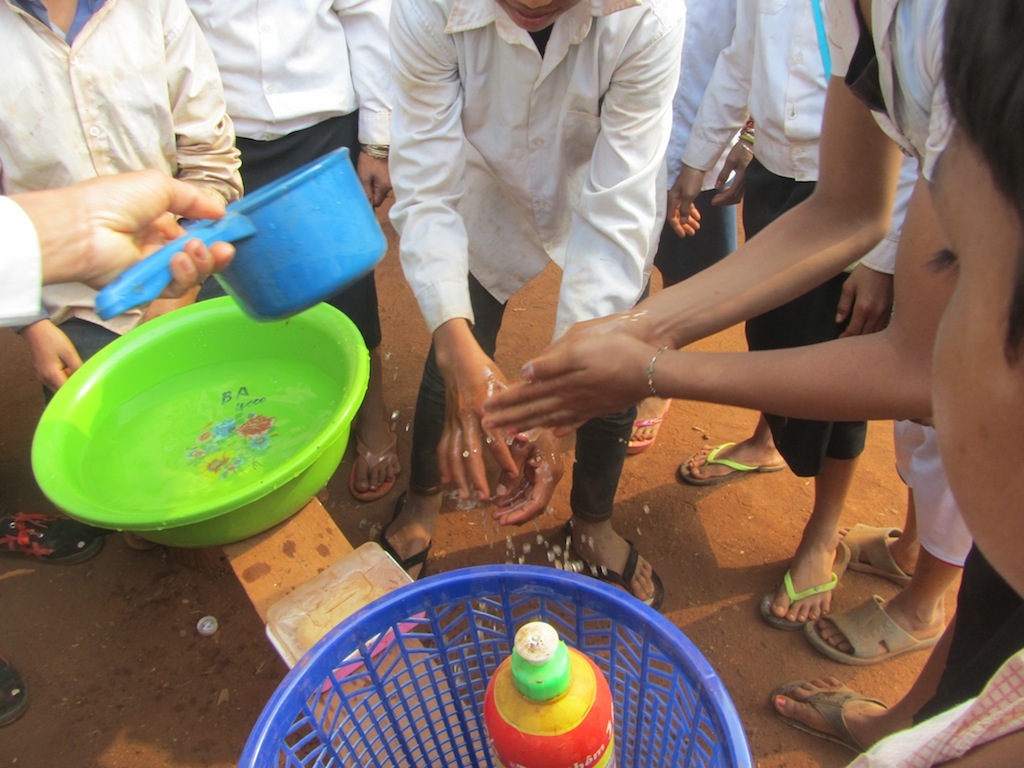
Following the training workshops, a Hygiene Fun Day was held in the schools to provide the students with health education on basic hygiene. Local community members were also invited to take part.  Children participated in interactive activities lead by teachers and VSO volunteers including a life-size snakes and ladders hygiene game that rewarded good health behaviours and sent you down the snake if you forgot what ‘good sanitation’ looked like.  Teachers and students enjoyed the introduction to new learning games.  

After the demonstration each classroom was provided with a 3-month supply sanitation materials.   Also, students from targeted schools were invited to design ‘Living Hygienically Posters to assess their understanding about hygiene ‘What does Hygiene mean to you?’   

As for La Mes Village School, one of the school we visited: It is important to note that this Village School is unique in that it is situated in a settlement owned and operated by a Vietnamese company. When we arrived at La Mes  Village Village School for the Hygiene Fun Day, the school was empty except for the onsite teacher who told us that the children were at the rubber plantation helping their parents collect sap.   Following our request for possibility to conduct the ‘Hygiene Fun Day’ workshop, the onsite teacher headed to the rubber plantation to ask the Vietnamese guard permission to assemble the community to participate in the Hygiene workshop.  20 minutes later, another teacher, students, parents, and a Vietnamese official arrived at the school to join the onsite teacher.  The Vietnamese official and parents looked on with wonder whilst teachers and students had a fun time participating with the interactive activities.  Despite the delay, despite the initial onset at La Mes Village School, we were pleasantly surprised to see smiling parents who appreciated the value of the workshop.  As they left the school, everyone, every parent, every student and children shook our hands and ‘humbly’ thanked us all. 

Since, we have returned to all the village schools to monitor their progress.  From our observation, it was evident that teachers and students had taken on the ‘Living Hygienically’ challenge with enthusiasm.  Teachers and students created schedules for students to assist in cleaning washbasins,  carry water from the wells nearby  each morning and more.   Also, both teachers and students tracked progress on their fun graphs showing that they were able to demonstrate proper techniques in living hygienically .  They appeared to be well aware of how germs are spread and how diarrhoea can be prevented. They also appeared to be more responsible for their own learning of what it means to ‘Live Hygienically’ without being prompted from their teachers.  

After one of our visits at one of the schools, we were once again pleasantly surprised to find that older students reminded everyone to wash their hands before returning to their classroom.   Although these are small changes and students still lack access to water supply or clean water supply, to a latrine at school, we are confident that through time, students will demonstrate long-term behaviour changes and evidently will become leaders in hygiene education within their school.  From these several hygiene training, it is hoped that students will also be able to disseminate this valid information amongst families and within their communities.  

by Tracy / Alice - Health and Education Cuso/ VSO Volunteers

More later ... :)

Monday, 27 July 2015

Round 2

- a hop, a skip and a jump 
Torrential rains drumming on rooftops at a speed of, so it seems, 50 kilometres an hour. Our lips are moving, but we cannot hear each other speak for we are deafened by the sound of the torrential rain. At Phnom Penh airport, we were greeted with heavy downpours - the heavens had opened up with no relief ... added to this, streets are persistently being flooded due to the plugged drainage system.  It’s also been hot and muggy. There’s been no mercy since we've been here, we’re either drenched with sweat or  we’re saturated with rain…   lol

June and July was a hop, a skip and a jump with so much to do, to say the least.  Though, as I speak, everything seems to be a blur, since so much has happened in such little time.

Two years ago today, before setting for Cambodia, we attended a SKWID training, went to China for a month, passed through the UK for 3 weeks and had a mere 2 weeks left to prepare for Cambodia.  I don’t know how we did it and I’m not sure if this time around, we could have been just as prepared as we were then.  In truth, I don’t think one can ever be fully prepared, no matter what the circumstance … Welcome to retirement!

Anyone for lemonade?
In early June, on our arrival in Canada we had a number of things to do; taking care of 'household' business, health, dental check up, finding a tenant, connecting our phone with Kudos phone plan, getting rid of never-ending stuff and more to prepare for round 2 – for Cambodia. 

Finding a tenant was a lot easier than we had initially anticipated.  I must say, we have great neighbours who helped us find a tenant.  Our next-door neighbour, Sarah immediately had put an add on her facebook, others passed it on by word of mouth and, our previous tenant advertised it on their University general email that reached everyone and beyond the University to other provinces.  As a result, in no time we had 15 people knocking on our door and, within a week, we found someone who met all the criteria – a young family who are a perfect fit for the neighbourhood… :)

As for connecting with a phone plan, (in Canada), coming back for a short interim from Cambodia, the technology of voice mail was too sophisticated for us to grasp, as a result we missed some very important 'voice' messages until late in the week when we activated our voice mail messages. Unbelievable ...

Unfortunately, we had limited time to see everyone - thankfully, we did however, manage to juggle our time with family and friends … :)  Despite our hectic time in Canada, we did manage to have fun with family and friends; we even got to 'join' our neighbour's lemonade 'parade' stand. We also went away for a week’s a holiday in Cuba to relax, to be ‘mindless!’ and, in the process, we met a wonderful couple, Jill and Raffi.  On our return from our holiday, we joined, for a day, thousands of fans at the 32nd Hillside Festival on the Island.  

Oh yes, and whilst we were both in Canada and the UK, we got to drink tap water.  It was heavenly indeed to say the least.

Thank you to everyone - family, friends, neighbours and colleagues for your warm well wishes, and of course, we'll attempt to keep you posted for Round 2, for another exciting time in Cambodia!

More later ... :)